
Ein internationales Forschungsteam unter der Leitung des Leibniz-Instituts für Astrophysik Potsdam (AIP) hat Licht in eine seit Jahrzehnten andauernde Debatte darüber gebracht, warum Galaxien sich schneller drehen als erwartet – und ob dieses Verhalten durch unsichtbare Dunkle Materie oder durch einen Zusammenbruch der Gravitation auf kosmischen Skalen verursacht wird. Unter der Leitung des AIP in Zusammenarbeit mit der University of Surrey, der University of Bath, der Nanjing University in China, der University of Porto in Portugal, der Leiden University in…
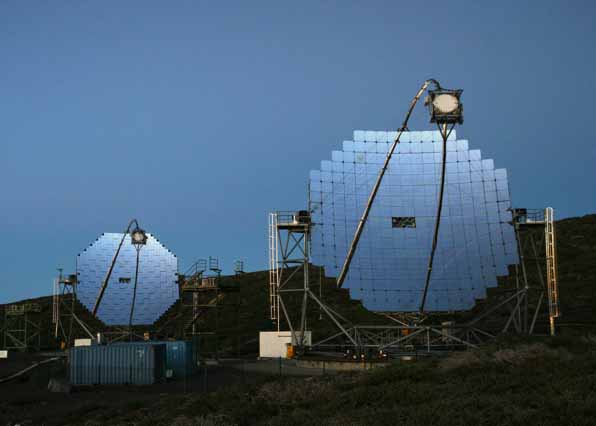
Bei dem Objekt QSO B0218+357 handelt es sich um einen Blazar, eine besondere Spezies eines Schwarzen Loches. Man geht heute davon aus, dass sich im Zentrum…

Ein länglicher anthrazitfarbener Körper, vier aerodynamisch geschwungene Flügel und ein hellblauer Kopf: Was erst einmal ungewöhnlich klingt, ist eine sehr…

Composite materials are nowadys used in many technical fields. Blades of wind power plants or aircraft parts, for example, are made out of these materials. In order to detect possible cracks or fractures, however, an immense effort is necessary. Conventional methods of material testing such as ultrasound, X-ray or thermography are very time-consuming, if they are possible to employ whatsoever. Other methods such as the use of strain gauges or glass fiber based systems can take measurements permanently, but they can only indirectly detect a fracture in the material. The invention is a novel, continuous measuring method, which is also suitable in particular for large-area applications such as, for example, wind turbine blades. The sensor consists of a braid of wires whose breaking behavior corresponds to that of the fibers in the composite material. The crossing points are connected via diodes. An electronic evaluation unit can switch between electrical paths through specific diodes so that the defective part can be identified in the breaking event.

„TRANSPIRE könnte ganz neue Perspektiven in der Telemedizin, Informationstechnologie und Sicherheitstechnik eröffnen“, erklärt Spinelektronik-Expertin Dr….
Nach derzeitigem Verständnis sind nur etwa 15 Prozent der Materie des Universums sichtbar, der Rest ist dunkel: Das heißt, er hat im Grunde genommen keine…

Dadurch, dass verlässliche Methoden fehlen, um Nanopartikel zu überwachen, und dass es eine unüberschaubare Zahl von Mechanismen gibt, die potenziell zu…
The production of recombinant proteins is a multi-billion dollar industry. In order to lower production costs, companies are very active in developing methods for increasing protein yield. However, current techniques are cumbersome, time consuming and consequently relatively expensive.
An innovative method, invented by a scientist at RWTH Aachen, is now about to close this gap in biotechnology. Briefly, the retention time of any target RNA can be significantly increased, leading to a substantially enhanced protein production. The astonishingly straightforward method can be applied in a wide variety of industry branches in white, red and green biotechnology.
An der Universität Konstanz konnte in einem von der Baden-Württemberg Stiftung geförderten Projekt ein sehr effizientes, iteratives Verfahren entwickelt werden, durch beliebig mehrfache Verdoppelung von Fettsäuren langkettige bis insbesondere ultralangkettige, endständig funktionalisierte, rein aliphatische Verbindungen darzustellen. Endständig funktionalisierte langkettige aliphatische Verbindungen stellen wichtige Verbindungen in technischen und biologischen Systemen dar. Beispielsweise können aus den so erhaltenen ultralangkettigen Verbindungen nachfolgend hochschmelzende, wasserunlösliche Polymere erzeugt werden, die dann keine aromatischen Bausteine enthalten. Das Verfahren nutzt leicht verfügbare Edukte aus nachwachsenden Rohstoffen. Weder werden halogenhaltigen Stoffe benötigt noch fallen diese als Abfall an.
Scientists of the Heinrich-Heine-University developed a rugged low-cost gas detector. The concept of detection based on the specific light emission of compounds excited electronically by an electric arc. The detection enables a wide range of measurments starting from pure gases down to gas traces (<1 ppm). Signals are achieved in tenths of seconds. At present, the invention is primarily concerned with monitoring operational states of fuel cells and appearing degradation processes in MEAs by detecting either nitrogen in the hydrogen flow or hydrogen within the cathode flow field. Granted US Patent und EP patent application, DE application for hydrogen detection. On behalf of the Heinrich-Heine-University of Düsseldorf, PROvendis offers interested companies the opportunity to obtain a licence for using the presented technology or for continuing the development of the method.

Nachdem die Polkappen schmelzen, wird auch die Nordwestpassage immer länger befahrbar – ihre wirtschaftliche Erschließung ist in greifbare Nähe gerückt. Selbst…

Um Wetterphänomene zu verstehen und vorherzusagen, ist es wenig sinnvoll, das Verhalten von einzelnen Wassertröpfchen oder Luftmolekülen zu betrachten….

Die Türme und Säulen in dem neuen Bild des Carinanebels bestehen aus riesigen Staub- und Gaswolken inmitten einer Sternentstehungsregion in einer Entfernung…

In ihrer mehrjährigen Zusammenarbeit zur Herstellung von ultrakalten Neutronen (UCN) haben Wissenschaftler der TU München (TUM) und der Johannes…
Itaconic acid is one of the top bio-based chemical building blocks and thus a promising platform compound for the production of polymers, coatings, chemical compounds and biofuels. It is an important monomer for the synthesis of, e.g. poly-acrylates, rubber, colours, additives, adhesives, emulsifying agents, lipids, pharmaceuticals, herbicides and biodegradable polymers for the packaging industry. The offered innovative production process of itaconic acid uses genes encoding for the biosynthesis pathway of unicellular fungi from the family of Ustilaginaceae, in particular Ustilago maydis. By modification of these genes the efficiency of itaconic acid production can be markedly improved and enables a more reliable process with less risk of batch failure.
As another advantage over A. terreus, which is also classified as a toxin-producing animal pathogenic fungus in certain countries which is limiting its applicability at industrial scale, the species Ustilago maydis has a history of safe use.

Anlässlich der Auftaktveranstaltung für das Testfeld Autonomes Fahren Baden-Württemberg (TAF BW) hat Verkehrsminister Winfried Hermann MdL am Montag, 31….

Für seine Beteiligung am Projekt „Special Holonomy in Geometry, Analysis, and Physics” erhält der Freiburger Mathematiker Prof. Dr. Sebastian Goette insgesamt…
 Rückmeldung


