



Forschungsergebnisse zeigen: Bupropion steigert die Libido bei Frauen, die unter vermindertem sexuellen Verlangen leiden
Almost since they were first invented, the reconfigurable computing platforms called “Field Programmable Gate Arrays” have had a reputation: “Good idea in theory, but…” Now, a University of Southern California computer scientist says two advances her team will report June 4 “will kick a lot of but.”
“Theoretically, FPGAs combine the speed of dedicated, application-optimized hardware with the ability to flexibly change chip resource allocation, so the same system can run many applications, optimized for each one,” explains Mary Hall, a project leader at USC’s Information Sciences Institute and research associate professor in the computer science department at USC.
“But FPGAs have historically been so hard to program that it’s been very hard and expensive to use these advantages. People say, ’good idea, but…’. We think the new work we report will clear away a significant number of these problems — will kick a lot of ’but,’” she said.
Both of the papers that will be presented at the June 2-6 40th Design Automation Conference in Anaheim, California apply sophisticated new compilation tools to configure FPGAs. Hall worked with Pedro Diniz, an ISI research associate and research assistant professor in the computer science department at USC, and USC graduate students.
One of the papers, by Hall, Diniz and graduate student Heidi Ziegler, describes analysis techniques to automatically translate programs written in C, a standard language widely used for conventional computers, into pipelined FPGA designs.
The other, by Hall, Diniz and graduate student Byoungro So, shows how what has long been a painfully slow trial and error process to fit the demands of an application to the characteristics of the software in optimal fashion can be automated.
“Together, these two techniques offer a low-cost, high-speed bridge from existing application software to the FPGA platforms,” Hall said.
“The key innovation in our work results from borrowing and adapting analysis and transformation techniques used in conventional multiprocessor systems.” Hall explained.
“Historically, these techniques have not been used in tools that synthesize hardware designs. When our higher-level analysis is combined with the strengths of synthesis tools, such as providing estimates of the characteristics of the resulting design, it becomes possible to automatically explore a collection of hardware designs, all based on a single high-level description of the algorithm.”
“We believe that with further development, this work and near-term follow-on will make FPGAs far more attractive options for many computer users.”
Hall said the “automated design space exploration” techniques described in the second paper would be useful in optimizing applications to all hardware, not just FPGAs.
“If you are trying to implement an application on a platform,” she explains, “you are always dealing with alternatives. You always different routes for achieving a result with the resources on the chip.
“So, for example, you need four sums. Do you want to have a single adder do it in four separate cycles, or do you want to exploit parallelism and have four adders do it at once?”
Traditionally, Hall said, the consequences of such decisions had to be worked out by hand, with assumptions verified by synthesis tools. “That can take hours or days.” said said. And since each stage of the design depends on the previous decisions, the the entire design space exploration process can be much longer, perhaps weeks to months for relatively simple designs.
To optimize software in this way for fixed-property chips, such a time penalty is acceptable. “But if you have to in effect do a custom redesign of the software for each application to take advantage of FPGA flexibility,” said Hall, “the potential usefulness of that flexibility is greatly reduced.”
The solution described doesn’t eliminate the task of fitting software to the chip, but it speeds it up by automatically eliminating most of the worst options. “the result is not perfect,” said Hall, “we estimate the performance is within a factor of two of hand-design. But we believe we can improve on that — and we have observed reductions in design time to be on the order of a factor of 100 or more.”
Hall, Diniz, and their collaborators have been developing FPGA programming under a program at ISI called Design Environment For Adaptive Computing Technology (DEFACTO, funded by the Defense Advanced Research Projects Agency (DARPA), and an ongoing project called SLATE (Compiler-Driven Design-Space Exploration for Heterogeneous Systems-on-a-Chip) funded by the National Science Foundation (NSF).
Founded in 1972, ISI is a part of the USC School of Engineering. More than 160 graduate level researchers create new information systems on two campuses in Marina del Rey, California, and Arlington Virginia.


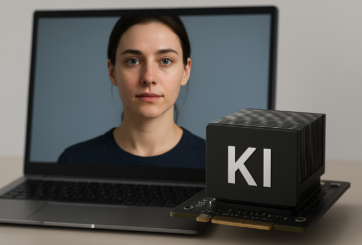
Das Forschungsprojekt „Gen-AIvatar – Universelle Erstellung von emotionalen und diversen Avataren durch generative KI“ erhält eine NEXT.IN.NRW-Förderung in Höhe von rund 2 Millionen Euro. Dabei entwickeln Wissenschaftlerinnen und Wissenschaftler der Universität Bonn und der TH Köln gemeinsam mit der MindPort GmbH eine neuartige, KI-gestützte Lösung zur Erzeugung von Emotionen für realistische Avatare. Gen-AIvatar entwickelt innovative und kosteneffiziente Methoden, um lebensechte Avatare zu erstellen. „Besonders wichtig ist uns eine ganzheitliche Animation, bei der Stimme, Körperbewegung, Gestik und Mimik im Einklang sind…
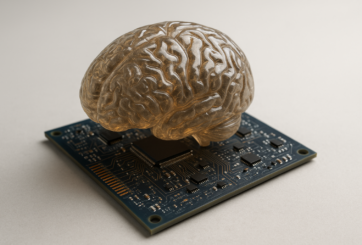
Physiker*innen der Universität Greifswald entwickeln einen innovativen Ansatz für ein deutlich energieeffizienteres Arbeiten von Computern. Ihr Lösungsweg ist inspiriert vom menschlichen Gehirn. Die rasante Entwicklung der Künstlichen Intelligenz (KI) stellt die heutige Computertechnik vor Herausforderungen. Herkömmliche Silizium-Prozessoren stoßen an ihre Grenzen: Sie verbrauchen viel Energie, die Speicher- und Verarbeitungseinheiten sind voneinander getrennt und die Datenübertragung bremst komplexe Anwendungen aus. Da KI-Modelle immer größer werden und riesige Datenmengen verarbeiten müssen, steigt der Bedarf an neuen Rechenarchitekturen. Neben Quantencomputern rücken dabei insbesondere…
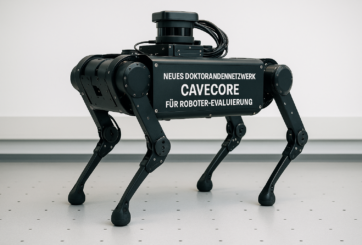
Wie können wir intelligente und lernfähige Roboter evaluieren? Woher wissen wir, ob solche Roboter gut sind in dem, was sie tun? Mit diesen Fragen beschäftigt sich CAVECORE – ein neues Marie Skłodowska-Curie Doctoral Network, das an der Universität Bremen koordiniert wird. Ab dem 1. September werden sich über einen Zeitraum von vier Jahren insgesamt 15 Promovierende im Rahmen von CAVECORE mit kognitiven Robotern beschäftigen – also mit Robotern, die mittels Sensoren ihre Umgebung erfassen, Informationen verarbeiten und häufig auch mit…

Fünf Jahre Innovation für Deutschlands digitale SicherheitCyberagentur feiert 5. Geburtstag in Halle (Saale) – Politik, Wissenschaft und Wirtschaft würdigen ErfolgeDie Agentur für Innovation in der Cybersicherheit GmbH (Cyberagentur) hat am 28. August 2025 in Halle (Saale) ihr fünfjähriges Bestehen gefeiert. Mit einem Rückblick auf fünf Jahre Forschungsarbeit, politischen Grußworten und der feierlichen Preisverleihung des Ideenwettbewerbs HAL2025 wurde das Jubiläum zu einem Zeichen für Deutschlands digitale Souveränität von übermorgen. Mit einer festlichen Veranstaltung beging die Cyberagentur ihren 5. Geburtstag. Zahlreiche Gäste…
 Rückmeldung
